Civil War History in Louisiana
Learn about Louisiana's Civil War history with these key sites.


At a Glance
- Explore significant Civil War sites in Louisiana: Visit historic battlefields, military forts, cemeteries and landmarks that reveal Louisiana's strategic importance during the Civil War.
- Discover museums and historic landmarks: Explore places like Port Hudson State Historic Site, Mansfield State Historic Site, the Old U.S. Mint and Louisiana's Old State Capitol to learn about key events, military campaigns and the people who experienced the war.
Many Louisiana sites indicate Civil War history. Landmarks range from State Historic Sites to battlefields, museums and cemeteries. These sites offer a regional perspective of the Civil War through immersive exhibits and artifacts.
Civil War Sites in South Louisiana
The Old U.S. Mint
A major federal facility at the time of Louisiana’s secession from the Union, the Old U.S. Mint provided the state government with a needed influx of cash. Later, when New Orleans had been captured by the Union, an enraged citizen, William Mumford, tore down a U.S. flag from the mint, for which act he was later hung. Today, the mint is a home for displays operated by the Louisiana State Museum and features rotating exhibits on various topics.
Louisiana’s Civil War Museum at Confederate Memorial Hall
The Confederate Memorial Hall Museum is one of the state’s oldest museums. With a collection of war memorabilia unmatched in the Deep South, this institution is a must-see for all Civil War enthusiasts. Tucked right in the heart of New Orleans’ museum district, it is easily accessible, and its rotating and permanent exhibits offer the visitor a truly personal experience of the war and its costs.
Louisiana’s Old State Capitol
Louisiana’s Old State Capitol served as the capitol in the decade before the Civil War and again from 1882 to 1932. It was the site of the state’s secession convention in 1861, when the legislature voted to secede from the United States of America and became The Sovereign and Independent Commonwealth of Louisiana, before joining the Confederate States of America. The Confederate state government abandoned the building with the approach of the Union fleet in the spring of 1862. The building was gutted by fire in December 1862 while occupied by Union troops. Today, it houses the Museum of Political History, with numerous exhibits on Louisiana’s colorful history.
Port Hudson State Historic Site

Centenary State Historic Site
Capitol Park Museum
Located in the Capitol Park area of downtown Baton Rouge, the Capitol Park Museum includes a nice set of exhibits, displays and kiosks that interpret multiple aspects Louisiana’s history, culture and commerce. You can learn about the plight of African Americans before and after the Civil War through exhibits on on slave markets, resistance, revolt and Jim Crow. The “Grounds for Greatness: Louisiana and the Nation” permanent exhibit covers everything from the Louisiana Purchase to the critical role Louisiana played in the Battle of New Orleans in the War of 1812, the Civil War and both World Wars. This ultimately leads to a display on the Baton Rouge bus boycott of 1953, which made national headlines and inspired civil rights leaders throughout the South – a significant impact on the Civil Rights movement.
Camp Moore
In the rolling countryside of Tangipahoa Parish, Camp Moore served as the primary training ground for Louisiana troops entering the Confederate army in 1861 and 1862. Despite its location in the healthy uplands north of Lake Pontchartrain, it nonetheless proved deadly for many of the young men thrown together in large numbers for the first time. Infectious diseases raged, and the lack of modern medical and sanitary facilities contributed to a high death rate long before any of the men saw the battlefield. Today a small museum can be found at the site with a plethora of displays and artifacts including clothing, shaving kits, dinnerware, artillery, money, uniforms, games and music that soldiers played. You’ll also find a collection of medicines and medical instruments from the period along with a large cemetery for those soldiers who died at the camp hospital.
Port Hudson State Historic Site
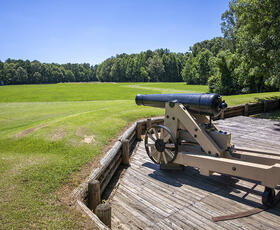
In conjunction with Union Gen. Ulysses S. Grant’s offensive against Vicksburg beginning in April 1863, Gen. Nathaniel P. Banks moved his army up from New Orleans to reduce the Confederate stronghold at Port Hudson, about 20 miles above Baton Rouge on the Mississippi River. Port Hudson was the longest siege in American military history. The garrison withstood the hardships for 48 consecutive days without relief from the outside. The starving garrison surrendered on July 9, after learning of the fall of Vicksburg a few days earlier. Today, Port Hudson State Historic Site features reenactments that include more than battles and soldiers. There are “sutlers” (civilian merchants who accompanied armies) selling reproduction items, ladies washing clothes and cooking as it would have been done in the 1860s and a Sunday morning church service.
Centenary State Historic Site
The charming little town of Jackson is the site of a skirmish associated with the Port Hudson campaign. Centenary State Historic Site, located in Jackson, is the original home of Centenary College (now in Shreveport). Just prior to the Civil War, around 250 students and 11 faculty members occupied the campus. However, the war forced the school to close as its buildings were used by both Confederate and Union troops. The dormitories became hospital space and housed many wounded and sick Confederate soldiers in 1862 and during the siege of Port Hudson in 1863, and Union troops used the Main Academic Building as an area headquarters. Those who passed on were laid to rest in a small cemetery located on the property.
Shadows-on-the-Teche
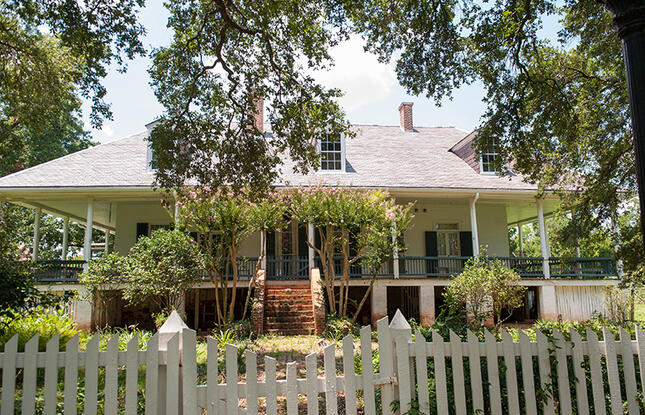
One of the few homes to survive the back and forth of the Confederate and Union armies in 1862 and 1863 was the well-known Shadows-on-the-Teche in New Iberia. Although her family fled, the Mistress of the house, Mary Weeks, stayed at the Shadows even as Union Troops occupied the mansion to serve as its local headquarters. While Union soldiers took over the Shadows’ main floor and outbuildings, Mary, her sister-in-law Hannah Jane Conrad, as well as enslaved house-servants Louisa, Charity, and Sidney, occupied the family quarters on the 2nd and 3rd floors. The home suffered the usual depredations of hungry troops in search of food, drink, and souvenirs. The site offers tours with a nuanced interpretation of the time period.
Civil War Sites in Central Louisiana
Forts Randolph and Buhlow State Historic Site
Imagine having to grow your own food, sleep in a tent and wait anxiously for battles that never came. That was the life of Confederate soldiers at Forts Randolph and Buhlow, located on the Red River in downtown Pineville. After the Battle of Mansfield in 1864 delayed the Union’s advance into western Louisiana, two earthwork forts were built on the banks of the Red River at Alexandria. The Confederates expected these forts to stop future Union attacks in North Louisiana, but the Confederate States Army surrendered shortly after the forts’ completion, and the site never saw action.
Louisiana History Museum
Nearby, the Louisiana History Museum features rotating exhibits on the development and history of Alexandria, Rapides Parish and Central Louisiana. Admission is free, and exhibits explore the state’s important industries, famous figures and more.
Alexandria National Cemetery
Alexandria National Cemetery was established in 1867 as a final resting place for Union soldiers who perished in Louisiana during the Civil War. It's difficult not to be moved by the long rows of uniform white headstones that stud the lawn. The cemetery was placed on the National Register of Historic Places in 1997.

Fort Randolph & Buhlow State Historic Site

Melrose Plantation
Frogmore Cotton Plantation & Gins
This working cotton plantation in Concordia Parish was the site of an encampment and skirmish for 1,776 Union troops led by Col. Bernard Farrar, including the Illinois infantry and heavy artillery. The plantation was part of the Natchez District, and many plantation owners in this region were Union rather than Confederate sympathizers. Take the "Plantation Civil War: Challenges and Changes" tour to learn about the many effects the war and Army occupation had on plantation owners, enslaved people and the women and children left behind.
Cane River Creole National Historical Park
In Natchitoches Parish, Cane River Creole National Historical Park encompasses several sites that provide perspective on the Civil War era and the lasting impacts of slavery and Reconstruction. Learn about the struggles and resilience of the region’s Creole communities and enslaved people at Oakland Plantation, Magnolia Plantation and Melrose Plantation, where tours offer glimpses of life before, during and after the Civil War.
Grand Ecore Visitor Center
About 4 miles north of Natchitoches, Grand Ecore Visitor Center served as an important staging point and supply depot for the Union Army and Navy during the Red River campaign. Sitting high on a bluff overlooking the Red River, it held a strategic position and was even utilized by Confederate forces, both before and after the spring 1864 invasion. Today, the Grand Ecore Visitor Center offers excellent exhibits on the site’s history and importance, as well as spectacular views of the river.
Civil War Sites in North Louisiana
Mansfield State Historic Site
After the fall of Vicksburg and Port Hudson in July 1863, the Mississippi River was entirely controlled by the Union. So, President Lincoln ordered the capture of Texas and the establishment of the Trans-Mississippi headquarters in Shreveport, Louisiana. The Union launched a successful Red River campaign to seize cotton and prevent French-Mexican forces from supplying and supporting Confederate troops. Approaching Shreveport from the south during the climactic period of the Red River campaign in spring 1864, Union Gen. Nathaniel Banks and his army met Confederates led by the charismatic Gen. Richard Taylor. Today, the Mansfield battlefield is preserved as the Mansfield State Historic Site. It features an excellent museum, interpretive trails and markers. Visitors can experience the Civil War through living history events, exhibits, battle reenactments and interpretive programs at the historic site. The site offers musket demonstrations, candlelight tours of the battlefield and more events throughout the year.

Mansfield State Historic Site
Louisiana State Exhibit Museum
Louisiana State Exhibit Museum
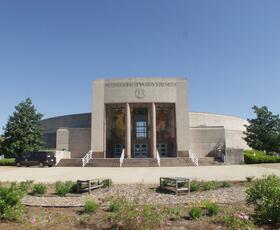
After Union General Nathaniel Banks captured Port Hudson in May 1863, Louisiana’s state capital officially moved to Shreveport, where it remained until the end of the war. The 43,000 Confederate soldiers in Shreveport were the last major Confederate force to surrender in early June 1865. The Louisiana State Exhibit Museum is a product of 1930s Louisiana, replete with larger than life murals and delicate, superbly crafted dioramas showing various aspects of the state’s industrial and agricultural life at the time, the Exhibition Museum also features an impressive collection of Civil War memorabilia sure to intrigue the interested visitor. The Louisiana State Exhibit Museum has a collection of handwritten documents from U.S. Treasury agents sent between Marshall and Shreveport in 1865, primarily concerning the Union seizure and transport of Confederate cotton stores in Marshall.
J. Bennett Johnston Waterway Shreveport Visitor Center
Located in downtown Shreveport, the J. Bennett Johnston Waterway Shreveport Visitor Center features exhibits on the history and navigation of the Red River, including its importance during the Civil War. Of great interest is the display on a Civil War-era steamboat that sank in the Red, only to be uncovered on dry ground when the river shifted course. It yielded a treasure trove of artifacts from the time period.
Frequently Asked Questions
What role did Louisiana play in the Civil War?
Louisiana played an important strategic and economic role in the Civil War because of its location along the Mississippi River, its agricultural economy, and its major port in New Orleans. Louisiana seceded from the Union in 1861 and joined the Confederacy. Union forces captured New Orleans in 1862 and later fought major campaigns throughout the state, including the siege of Port Hudson and the Red River Campaign.
What are popular Civil War sites in South Louisiana?
South Louisiana is home to several important Civil War landmarks, museums and historic sites. Popular destinations include the Old U.S. Mint and Confederate Memorial Hall Museum in New Orleans, Port Hudson State Historic Site near Baton Rouge, Camp Moore Museum and Cemetery in Tangipahoa Parish and Shadows-on-the-Teche in New Iberia.
What are popular Civil War sites in Central Louisiana?
Central Louisiana features several historic sites connected to the Red River Campaign and the Civil War's impact on the region. Popular destinations include Forts Randolph and Buhlow State Historic Site in Pineville, Alexandria National Cemetery, Grand Ecore Visitor Center near Natchitoches, Frogmore Cotton Plantation and Gins and Cane River Creole National Historical Park.
What are popular Civil War sites in North Louisiana?
North Louisiana offers several destinations where visitors can learn about the Red River Campaign and the region's strategic importance during the Civil War. Popular sites include Mansfield State Historic Site, Pleasant Hill Battlefield, Louisiana State Exhibit Museum in Shreveport and the J. Bennett Johnston Waterway Regional Visitor Center in Shreveport.
What were the major Civil War battles and campaigns fought in Louisiana?
Some of the most significant Civil War military engagements in Louisiana included the siege of Port Hudson in 1863 and the Red River Campaign in 1864. The Battles of Mansfield and Pleasant Hill were important Confederate victories during the Red River Campaign, which was intended to give Union forces greater control over western Louisiana and access to the Trans-Mississippi region.
Where can I visit Civil War battlefields and historic sites in Louisiana?
Louisiana has numerous Civil War historic sites, battlefields, museums, and cemeteries open to visitors. Notable destinations include Port Hudson State Historic Site near Baton Rouge, Mansfield State Historic Site in North Louisiana, Forts Randolph and Buhlow State Historic Site in Pineville, Camp Moore Museum and Cemetery in Tangipahoa Parish and Centenary State Historic Site in Jackson.
What museums in Louisiana feature Civil War history and artifacts?
Several Louisiana museums offer exhibits and artifacts related to the Civil War. These include Confederate Memorial Hall Museum and the Old U.S. Mint in New Orleans, Capitol Park Museum and Louisiana's Old State Capitol in Baton Rouge, the Louisiana State Exhibit Museum in Shreveport and the visitor center at Forts Randolph and Buhlow State Historic Site in Pineville.